
Moving Through Motherhood: Why Softening Your Blocks is Better Than Bulldozing
The Deeper Parts of Motherhood
In this space, I talk about all things pregnancy, postpartum, and motherhood. But it’s not just life and kids. It’s the deeper parts of motherhood—the parts that change us, the parts that frustrate us, the parts that are reflected back to us.
Today, I want to talk to you about blocks. What are they? What do they help us do? I want to share how I’ve become familiar with mine so that I can begin to soften them.
The Difference Between Softening and Bulldozing Through Blocks
I know there is a way to just bulldoze your way through a block—trust me, I have bulldozed my way through and been so harsh towards myself. Maybe I made some headway in that moment, but in actuality, I just built a stronger wall and built more resistance.
What I have done is repeated a form of abandonment and disregard, and built more distrust with myself. I am simply repeating the pattern of what the block was trying to protect me from.
And I am wanting to build a different way of relating. One more spacious, open and curious.
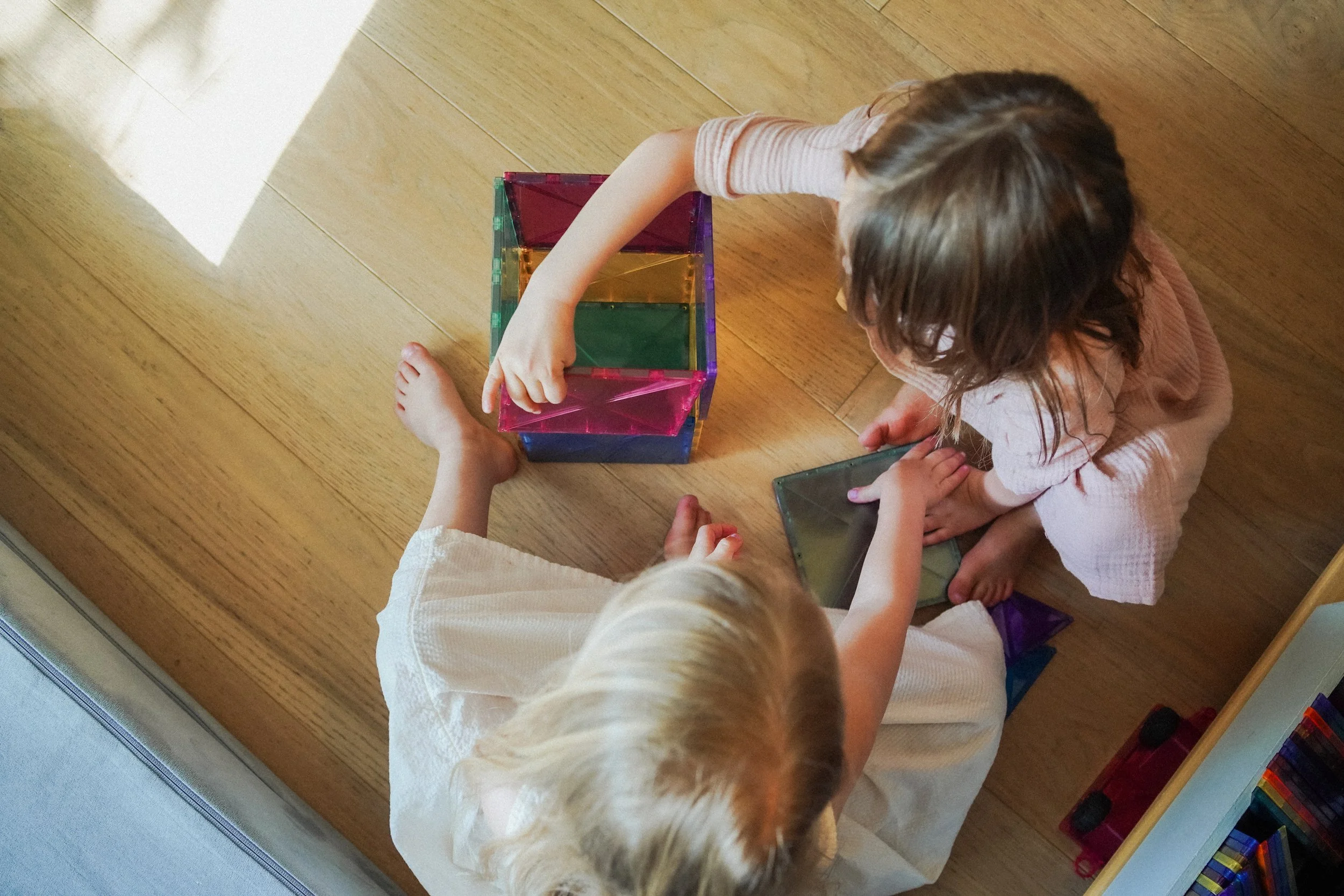
I think about my kids building with magnetic tiles or wooden blocks. It’s not as simple as just crushing it, and I wish it were. The building of the block was slow. It was meticulous. It took time and had a purpose—it wasn't built to create pain. It had a purpose to protect me.
Regardless of what block it is, it now lives lodged in my regulation system (aka nervous system) doing a really good job at "protecting me." Yet that protection at some point turned into preventing me from living the life I wanted. I am learning how to "protect myself" by allowing the blocks to soften.
How to Challenge Inherited Beliefs and Messages
I’ve learned that when I slow down and meet my block with so much softness and curiosity, the block seems to melt. I find that when I meet the block, it has a message or a belief behind it and I now get to question and challenge that belief. Does it align to what I know and believe to be true or was this a message I internalized and picked up along the way?
To make this more real, I am going to share about a block I had in receiving during one of my postpartum experiences. I had a hard time asking for help and receiving help. If someone offered—I'd deny it and say, "Oh no, I've got it, thank you," when in actuality I didn't have it. I felt icky, like guilty to receive. I was afraid I'd owe them or be indebted and didn't have a way to give back or return the favor.
The inherited message was I was unworthy of such kindness.
The block for asking for help was fear of judgment—the belief that if I asked for help I was weak or less than. That I would be criticized for not having it all together and I was afraid of people seeing the messy undone side of me. I had always upheld the facade of having it all together and one of my postpartum broke that and I hurt myself trying to uphold that message that I had to have it all together and do it all.

In sitting with my block to receive, I actually softened the block completely and opened myself up to challenge the messages and beliefs. I am now more open to receive. I know I am worthy to receive. I am allowed good to flow in my life. I can ask for help, I allow myself to be me—messy and real—and I think that is where the magic actually lives.
What My Daughters BIg Emotions Taught Me About Emotional Regulation
It’s like when my kids have a big emotion. It feels big. They all feel and respond differently, however, one of my kids runs around when the emotion is literally in movement or in motion through her little body. The emotion is so big in her body that she runs around. I used to run after her like, "I’m here, I’m here!" but then I realized that her emotions only got bigger and lasted longer, like WWWWAAAAAYYYY longer.
Instead, I’ve noticed that if I sit and let her emotion run through her, she lands in my lap. I stay steady and present, attuning to her silently, and you know what? The emotion lasts somewhere between 1–2 minutes. That's it. Sometimes it’s simply allowing the emotions to move through them and providing space if they want to share and I'll listen, openly and with curiosity (not perfectly and with as much presence and love as I can offer them in that moment—and to me that is enough).
PS: There is an incredible book called The Rabbit Listenedby Cori Doerrfeld has changed and supported the way I show up when emotions arise in my children and I have the desire to fix or change it. Absolutely an amazing book and I highly recommend it.
Tending to the Parts: How to Practice Self-Compassion
That’s the idea I want for myself with each block I meet: I want to simply sit and listen, not fix, not change, but wait for it to metaphorically land in my lap. I don’t know if I can say with 100% confidence that it ever fully goes away; there is probably always residue or the familiar analogy of pulling back an onion—layer after layer.
I remember when I first started this journey of "melting my blocks," I felt so frustrated because in part it was protecting me, but it was also preventing me from living the life I knew I wanted. At the end, I had so much gratitude for what it was trying to prevent or protect me from feeling.
A Question for You
I want to play around with this idea: can we be so grateful for the block? If you aren't ready to sit with it and name it yet, I invite you to begin with a question: "What did the block protect me from? Who did it protect me from?"
Once I have that answer, I find that gratitude can come in. The block doesn’t want to break me. It simply wanted to protect me. I’m choosing to stay soft, curious, and open.
I am here to witness you and meet you. If you'd like to discover the parts of you that are protecting you and preventing you to live out who you are called to be —or if you'd like to learn more about my offerings—[click here to join my newsletter community.]
Sending you so much love.
